演講與活動
【專題演講】115/10/22(四) 15:30-16:30 楊昊紘 博士後研究員
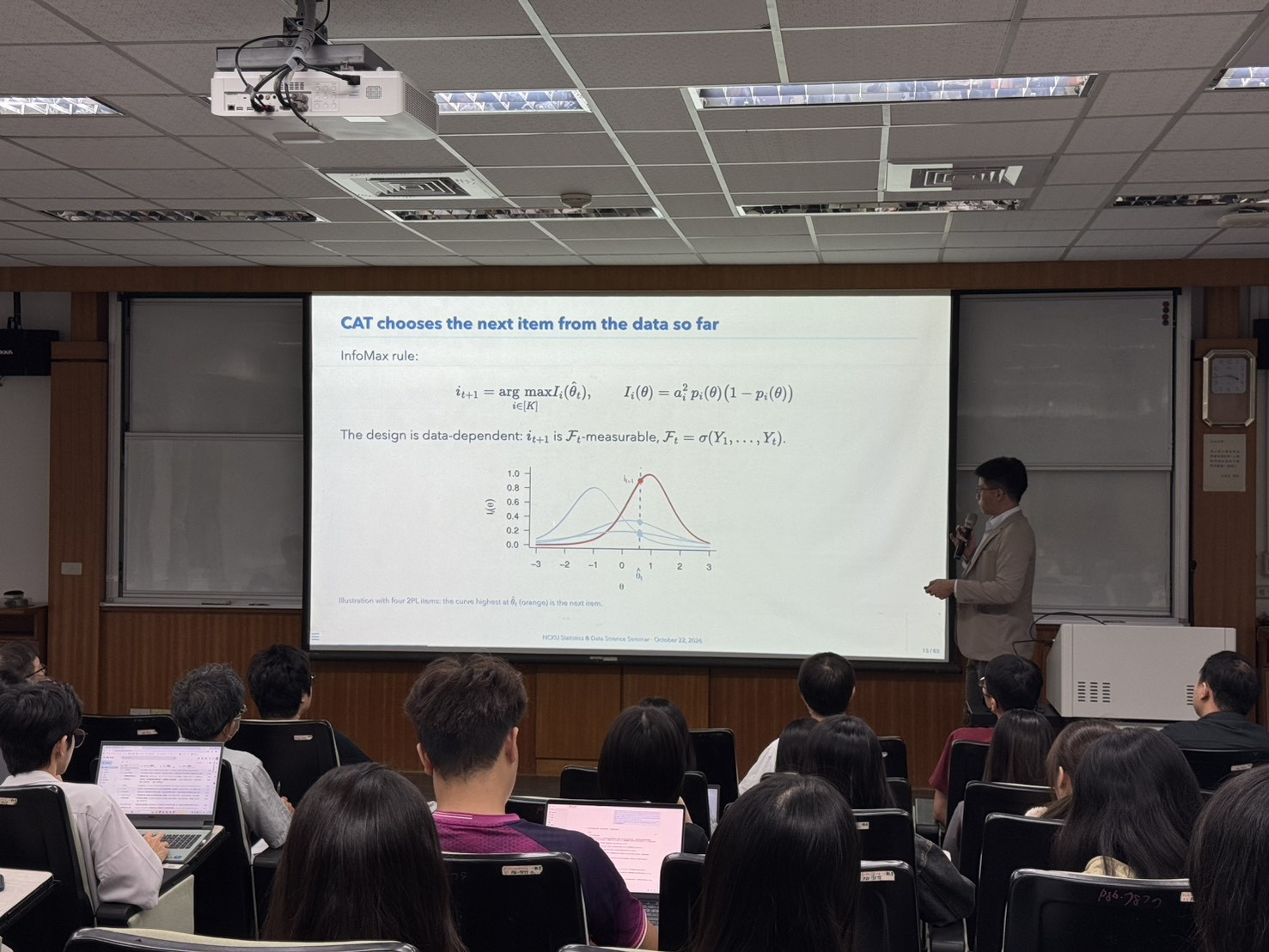
Computerized adaptive testing (CAT) chooses each item from the responses observed so far, so its data are
neither i.i.d. nor collected under a fixed design. Existing theory is large-sample: under the Rasch model with
maximum-information selection, the ability estimate is consistent and asymptotically normal (Chang & Ying,
2009), which justifies a Wald interval at a single, pre-specified test length. Real tests, however, are monitored
after every item and may stop early. In a 2PL simulation checked after each of 50 items, the simultaneous
coverage of the nominal 95% Wald interval falls to 0.72.
This talk develops finite-sample guarantees for CAT by treating it as an online learning problem. First, because
the score process is a martingale, I construct confidence sequences: intervals valid at every test length
simultaneously, and therefore under any stopping rule. I compare four constructions: asymptotic, Azuma
Hoeffding, Bernstein, and a likelihood-ratio mixture justified by Ville's inequality. Second, I show that
maximum-information selection is follow-the-leader in online convex optimization and attains O(√(T log T))
information regret with high probability. Third, borrowing the upper-confidence-bound principle from multi
armed bandits, I propose CS-UCB, which selects items through the confidence sequence and achieves the
same rate. In simulation, the mixture sequence keeps coverage at every test length near 0.96 with moderate
width. Across about 12 million simulated tests, InfoMax remains hard to beat on RMSE, and CS-UCB comes
closest.